On This Page
- Key Facts
- The Family Office Argentina Landscape
- Comparison of Argentine Wealth Platforms
- Top Picks by Strategy
- Top Family Offices in Argentina in Detail
- Investment Trends Shaping This Market
- How to Evaluate a Wealth Advisor in Argentina
- Which Family Office Fits Your Needs?
- Methodology
- Frequently Asked Questions
Key Facts
- An estimated 12 to 15 family offices operate in Argentina, with the majority based in Buenos Aires.
- Most Argentine family offices sit within large conglomerates. The Techint Group (Rocca family) generates $34 billion in annual revenue as the largest.
- Buenos Aires accounts for roughly 15% of Argentina's GDP, producing about $95 billion annually as the country's financial hub.
- Three dedicated multi-family offices serve UHNW families in Buenos Aires, including Humboldt Family Office and two independent advisory firms.
- Argentine families increasingly structure wealth through Uruguay, Switzerland, and the United States to hedge against peso volatility and capital controls.
- Vaca Muerta shale development and fintech expansion are the two fastest-growing allocation themes among local family offices.
- Entry thresholds range from $50 million to $500 million or more, depending on office type and service model.
The Family Office Argentina Landscape
Argentina's wealth management ecosystem differs from those in the United States or Europe in one critical way: most offices sit within large industrial conglomerates rather than operating as standalone platforms. The Rocca, Perez Companc, Bulgheroni, and Werthein families manage dynastic capital through their operating businesses, blending corporate strategy with wealth preservation.
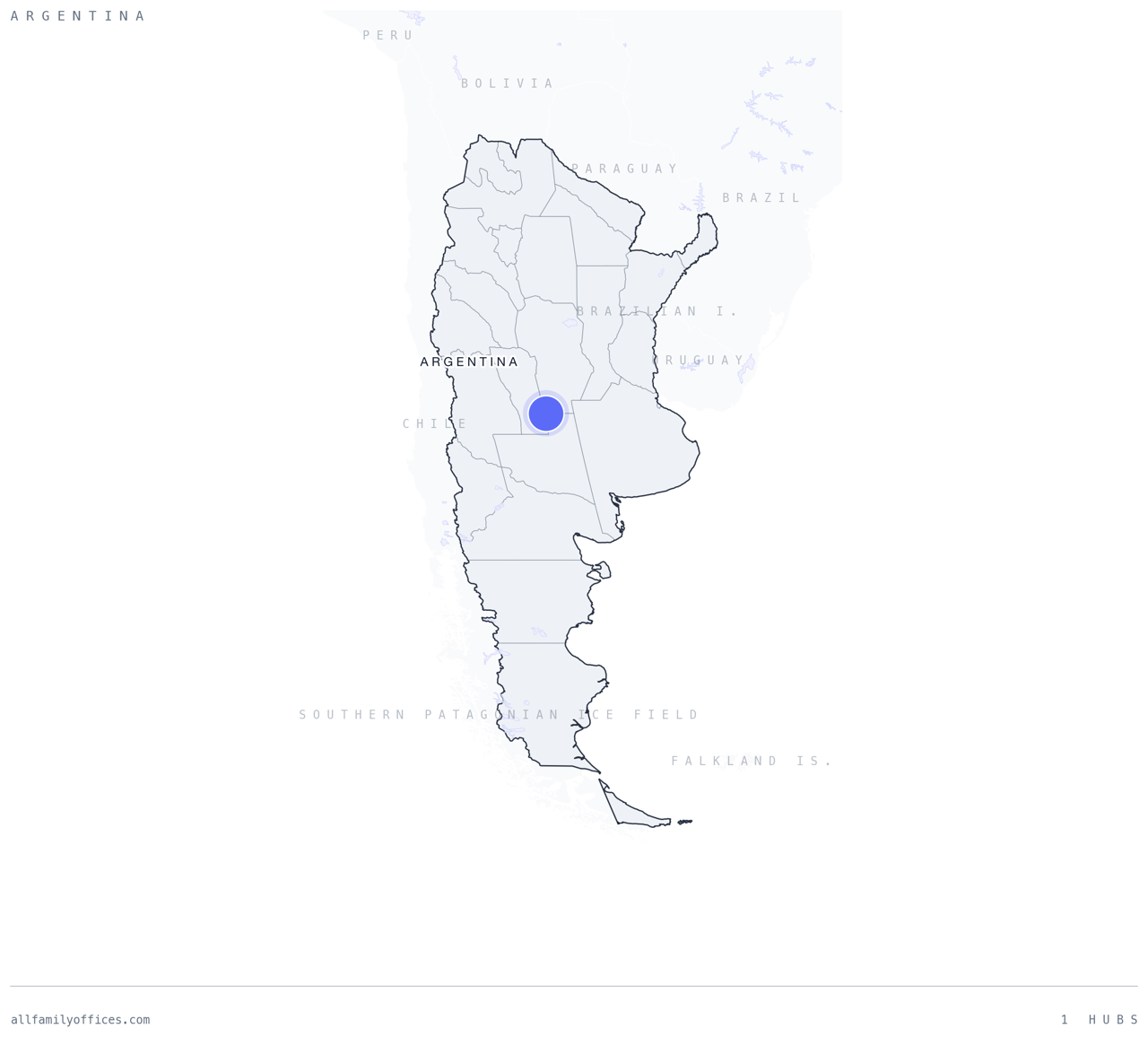
Buenos Aires serves as the base for virtually all of these entities. Offices concentrate in Puerto Madero, the Catalinas business district, and Retiro. The city produces about $95 billion in annual GDP, making it the country's financial center.
Persistent inflation, peso devaluation, and Central Bank (BCRA) capital controls force families to think in multi-jurisdictional terms. Montevideo, Miami, and Zurich function as satellite hubs where Argentine families hold structured assets outside local currency risk.
Argentina's private sector employs 29% of the national workforce. Commodity wealth from agriculture (55% of exports) and energy (Vaca Muerta shale) continues to generate new fortunes that require formal wealth management. Dedicated advisory firms remain scarce compared to mature markets. Only three MFOs serve local families, while top-ranked law firms provide estate planning and cross-border structuring. International service providers maintain Buenos Aires offices to help families with fideicomiso (trust) structures and consolidated reporting.
Comparison of Argentine Wealth Platforms
The table below maps the principal family offices and advisory firms active in Argentina. Because most embedded single family offices (SFOs) do not disclose AUM figures, the table focuses on type, capital deployment focus, and services instead.
| Family Office | Type | Investment Focus | Services | Location |
|---|---|---|---|---|
| Techint Group (Rocca Family) | SFO/Embedded | Steel, construction, energy, mining | Direct capital deployment, operating companies | Buenos Aires |
| Grupo Perez Companc | SFO/Embedded | Energy, food & beverages, agribusiness | Direct allocations, operating companies | Buenos Aires |
| Grupo Werthein | SFO/Embedded | Telecom, fintech, satellite broadband | Direct investments, venture launches | Buenos Aires |
| Pan American Energy (Bulgheroni Family) | SFO/Embedded | Oil & gas, Vaca Muerta upstream | Direct investments, energy systems | Buenos Aires |
| Grupo Financiero Galicia (Escasany Family) | SFO/Embedded | Banking, fintech, insurance | Financial services, portfolio management | Buenos Aires |
| IRSA (Elsztain Family) | SFO/Embedded | Real estate, banking | Property development, asset management | Buenos Aires |
| Grupo Supervielle | SFO/Embedded | Banking, insurance, asset management | Full-service financial group | Buenos Aires |
| Independent Fee-Only MFO | MFO | Wealth management, private banking | Fee-only advisory, estate planning, tax structuring, consolidated reporting | Buenos Aires |
| Full-Service Advisory Platform | MFO | Wealth management, corporate finance, agro | Portfolio management, succession planning, family governance, BCRA advisory | Buenos Aires |
| Román Family Office | SFO | Ports, logistics, impact investing | Impact assessment, risk management, compliance | Buenos Aires |
| Humboldt Family Office | MFO/VC | Latin American venture capital, private equity | Direct investments, fideicomiso vehicles | Buenos Aires |
Embedded SFOs dominate this market. Families with roots in steel, energy, banking, and agriculture control the largest pools of capital, but they rarely offer external advisory services. UHNW families seeking independent advice must turn to the small MFO sector or international providers.
Top Picks by Strategy
- Largest by Revenue: Techint Group (Rocca family), $34 billion in annual revenue from steel, construction, and energy operations in 25 countries.
- Best for Direct Energy Allocations: Pan American Energy (Bulgheroni family), a core upstream partner in Vaca Muerta alongside Shell and Chevron.
- Top Real Estate Allocator: IRSA (Elsztain family), Argentina's largest real estate company, with Alto Palermo generating the highest retail sales per square meter in the country.
- Strongest MFO Platform: Buenos Aires' only fee-only, non-discretionary multi-family office, offering consolidated reporting and independent advice.
- Leading Fintech Innovator: Grupo Werthein, which launched skx fintech with R$1 billion in planned funding and partnered with Amazon's Project Kuiper for satellite broadband.
- Best for Impact Investing: Román Family Office, which integrates purpose and sustainability into every capital decision.
- Top Agribusiness Play: Grupo Perez Companc, owner of Molinos Agro, Argentina's leading agricultural exporter, with over 30 food and beverage brands.
- Most Complete Advisory Services: The local full-service advisory platform, serving companies, institutions, and families with wealth management, BCRA advisory, ESG integration, and agro finance.
Top Family Offices in Argentina in Detail
Techint Group (Rocca Family)
No other Argentine wealth platform matches Techint's global industrial footprint. The group's subsidiary Tenaris is the world's premier pipe maker for the energy sector, operating in 25 countries. Tecpetrol produces 193,000 barrels of oil equivalent daily. Techint E&C has completed over 3,300 construction projects.
Now in its third generation under CEO Paolo Rocca and chair Gianfelice Rocca, the group generates $34 billion in annual revenue. Techint functions less as a traditional family office than as a multinational conglomerate with embedded wealth management. Families in heavy industry or energy will find this operating model instructive as a benchmark for how Argentine dynastic capital achieves global reach.
Grupo Werthein
The Werthein family turns distribution networks into financial systems. Through Vrio, they operate DirecTV Latin America and Sky Brasil. In 2024, Vrio partnered with Amazon's Project Kuiper to deliver satellite broadband to seven South American countries.
The family also launched skx, a fintech platform targeting payments, cards, and working-capital products. This venture has R$1 billion in planned funding through 2026. The "pipes to payments" strategy converts telecom subscribers into bankable customers. This approach highlights the shift from traditional media toward embedded finance in Argentine family capital.
Grupo Perez Companc
This third-generation group executed one of Argentina's most notable strategic pivots. After selling Petrolera Pérez Companc to Petrobras in 2002, the family redirected capital into food, beverages, and agribusiness. Molinos Agro became the country's top agricultural exporter.
In 2015, the group re-entered energy services by creating PeCom, now Argentina's largest oil and gas services provider. With $3.4 billion in annual revenue and over 30 consumer brands, Grupo Perez Companc shows how Argentine families use sector rotation to preserve wealth through economic cycles. Luis Perez Companc chairs the board.
Grupo Financiero Galicia (Escasany Family)
Banco Galicia serves over 3 million customers and holds roughly 11% of Argentina's private-sector loan market. The Escasany family's financial group includes fintech arm Naranja X, insurance provider Galicia Seguros, and portfolio management unit Fondos Fima.
Banco Galicia was the first Latin American bank to trade on a US stock exchange. With $2.5 billion in revenue, this third-generation private wealth office operates at the intersection of traditional banking and digital financial services. Eduardo Escasany chairs the company his grandfather co-founded.
Pan American Energy (Bulgheroni Family)
The Bulgheroni family controls one of Argentina's most strategic energy assets. Pan American Energy (PAE) is a core upstream partner in Vaca Muerta, the shale formation holding the world's second-largest gas reserves and fourth-largest oil reserves.
PAE operates alongside Shell, Chevron, and Vista in developing pipeline systems and an LNG export pathway targeted for 2029. For families or investors focused on Latin American energy transition, PAE represents the operator-level expertise that defines Argentine hydrocarbon wealth.
Buenos Aires Independent MFO
This firm fills a critical gap in Argentina's advisory market: independent, conflict-free wealth advice. Operating on a strict fee-only, non-discretionary model, it is the most visible dedicated MFO in the country. Clients pay the firm directly. It accepts no commissions from product providers.
CEO Javier Schrager, an actuary from Universidad de Buenos Aires, launched the firm in 2014 after 15 years in the financial sector. Services span portfolio management, private banking, external CFO functions, estate planning, tax structuring, family oversight, and consolidated reporting. UHNW families who want independent advice without bank-affiliated conflicts will find this model rare in Argentina.
IRSA (Elsztain Family)
Argentina's largest real estate company manages a portfolio of shopping malls, offices, hotels, land reserves, and residential properties. Alto Palermo generates the highest sales per square meter of any retail space in Argentina.
IRSA also holds roughly 30% of Banco Hipotecario, one of the country's leading financial institutions. Eduardo Elsztain has chaired the firm since acquiring it in 1991. Five of his brothers serve as directors or lead business segments. With $270 million in annual revenue, this dual-track model of property and banking runs through the Elsztain family's strategy.
Román Family Office
Purpose-driven capital defines this Buenos Aires SFO. Evolved from Organización Román's transportation and logistics business (started in 1961), the family built ITL, Argentina's first private container port. In 2008, they formed a strategic alliance with PSA (Port Singapore Authority).
Today, chair Karina Román and director Silvina Román lead the office with an explicit impact investing mandate. The youngest generation's emphasis on purpose and sustainability makes this firm stand out in a market where most family wealth flows into traditional sectors.
Full-Service Local Advisory Platform
Few Argentine firms combine corporate finance and private wealth advisory under one roof. This platform offers estate planning, allocation policy development, portfolio management, succession planning, family governance, and BCRA regulatory advisory in a single engagement.
The firm also integrates ESG criteria and offers agro finance, reflecting the agricultural wealth that underpins many Argentine fortunes. Ivan Vizental serves as a visible spokesperson. Families with active operating businesses alongside personal wealth will find this combined offering hard to match locally.
Investment Trends Shaping This Market
Vaca Muerta Energy Development
Argentina holds the world's second-largest shale gas reserves and fourth-largest shale oil reserves, concentrated in the Vaca Muerta formation. The Bulgheroni family's PAE and Techint's Tecpetrol are key operators. Government incentives for the Vaca Muerta Sur pipeline and a floating LNG export project (2029 horizon) draw family capital into upstream production and midstream systems. Unconventional oil and gas production rose 26% from 2022 levels.
Fintech and Embedded Finance
The Werthein family's skx fintech launch, backed by R$1 billion in planned funding, exemplifies a broader shift. Grupo Financiero Galicia's Naranja X is another example of families building digital financial rails on top of existing customer bases.
Buenos Aires ranks as South America's second-largest tech startup hub behind São Paulo. This talent pool lets family offices tap into venture allocations through vehicles like Humboldt Family Office's fideicomiso structures.
Cross-Border Wealth Structuring
BCRA capital controls and peso volatility push Argentine families to hold assets in Uruguay, Switzerland, the United States, and Panama. International firms maintain Buenos Aires offices to facilitate multi-jurisdictional structures. Consultatio S.A. (Costantini family) already operates in Argentina, Uruguay, and the US.
Offshore structuring is not optional for Argentine wealth preservation. Inflation can erode peso-denominated portfolios within months. Fideicomiso vehicles and international trust providers give families the tools to hedge this risk.
Renewable Energy and Industrial Decarbonization
Aluar (Madanes family) partnered with Danish firm Vestas in 2022 to power its aluminium smelting plant with wind energy. Argentine families frame renewable capital expenditure as operator-driven spending with contracted cash flows, not as thematic ESG plays. Aluar's 460,000-tonne annual aluminium capacity makes cost-effective power sourcing a competitive necessity.
How to Evaluate a Wealth Advisor in Argentina
Conflict-free independence is the first criterion. In a market where most advisory flows through bank-affiliated channels, a fee-only model sets the benchmark. Verify whether an advisor earns commissions from product providers or receives payment solely from clients. This distinction matters more in Argentina than in markets with stronger fiduciary oversight.
Cross-border structuring expertise is non-negotiable. Any firm serving Argentine clients must demonstrate fluency with BCRA foreign exchange regulations, fideicomiso trust structures, and multi-jurisdictional reporting. Ask for specific examples of structures in Uruguay, Switzerland, or the United States. Band 1 Chambers HNW-ranked private wealth law firms set the standard for legal and tax planning in Buenos Aires.
Track record through peso crises separates tested advisors from untested ones. Argentina's inflation and currency history means any office managing local wealth should show how portfolios performed during devaluation events. Consolidated reporting that tracks assets in multiple currencies and custodians is essential. Both leading local MFOs list this as a core service.
Regulatory compliance with CNV (securities commission) and BCRA requirements deserves scrutiny. Look for certifications such as ISO 27001, ISAE 3402, or credit ratings from agencies like Fitch. Firms lacking these credentials may pose compliance risk in a market where regulatory standards continue to tighten.
Succession planning capabilities matter for multi-generational wealth. The Brito heirs (six children inherited Banco Macro's controlling stake in 2020) and the Supervielle dynasty (now in its fourth generation) illustrate how active this concern remains in Argentina. Evaluate whether the office provides next-generation education, dispute resolution support, and formal family structures.
Which Family Office Fits Your Needs?
Ultra-high-net-worth families with $100 million or more in liquid assets and a need for independent advisory should explore fee-only MFO models or full-service platforms in Buenos Aires. Both offer consolidated reporting, tax planning, and family oversight. The fee-only approach suits families who want to retain decision authority. A corporate finance-focused firm serves families with active operating businesses alongside personal wealth.
Business owners planning liquidity events or sector transitions can study the Perez Companc playbook: exit one sector, redeploy capital into another, and build operating companies rather than passive portfolios. For families with real estate holdings, IRSA and Consultatio show two models of property-based wealth building at scale. Those seeking legal structuring for estate planning should prioritize a Band 1 Chambers HNW-ranked firm with deep expertise in fideicomiso vehicles and cross-border planning.
Next-generation wealth holders drawn to venture capital and impact investing have limited but growing options. Humboldt Family Office channels capital into early-stage Latin American companies through fideicomiso vehicles. The Román Family Office offers a model where impact and purpose guide every allocation decision. For institutional allocators seeking co-investment alongside Argentine families, the embedded SFOs (Techint, PAE, Werthein) act as principals in control deals, often without private equity intermediaries, creating direct partnership opportunities for aligned capital.
Methodology
This guide to family office Argentina draws from publicly available financial disclosures, corporate profiles, and industry rankings as of 2025. Office selection prioritized entities with verifiable Buenos Aires operations, documented capital deployment activity, and identifiable family control. Revenue figures come from corporate reporting and market research. The landscape reflects 12 to 15 identified family offices, though the actual count may be higher given that many Argentine families manage wealth informally through conglomerate structures. AUM data is limited because most Argentine family offices do not disclose managed assets publicly. Where specific figures are unavailable, the article describes focus areas and revenue instead.
Frequently Asked Questions
An estimated 12 to 15 are based in Argentina, with nearly all headquartered in Buenos Aires. The majority sit within large conglomerates like Techint, Grupo Perez Companc, and Grupo Werthein. Only three dedicated MFOs operate locally, including Humboldt Family Office. International service providers maintain Buenos Aires offices, expanding the advisory ecosystem for wealthy families seeking independent advice.
Thresholds range from $50 million to $500 million or more. A single family office typically requires $100 million or above to justify standalone costs of $1 million to $2 million per year. Multi-family offices serve families at lower thresholds by sharing overhead. Outsourced models through top-tier law firms can serve families with $10 million to $30 million in assets under management.
A single family office manages wealth for one family. In Argentina, most SFOs sit within conglomerates. The Rocca family's Techint Group and the Bulgheroni family's Pan American Energy are examples. A multi-family office serves multiple families, distributing operating costs. The key distinction is independence: MFOs can offer conflict-free advisory, while embedded SFOs prioritize the controlling family's operating businesses.
Persistent inflation, peso devaluation, and BCRA capital controls make international structuring essential for wealth preservation. Argentine families commonly hold assets through entities in Uruguay, Switzerland, the United States, and Panama. Fideicomiso (trust) structures regulated by Argentina's CNV provide domestic options, while international service providers facilitate cross-border arrangements. This structuring responds to currency risk that can erode peso-denominated portfolios, not tax avoidance.
Wealth advisory firms cluster in three Buenos Aires districts. Puerto Madero houses international fiduciary providers at the World Trade Center and Torre Catalinas Plaza. The Catalinas business district hosts Consultatio's Alem Plaza development. Other firms operate from Eduardo Costa in the CABA area and Avenida Eduardo Madero. Retiro and Microcentro round out the financial core.
Steel and construction lead, with the Rocca family's Techint Group generating $34 billion in annual revenue. Quick-service restaurants follow through the Staton family's Arcos Dorados ($4 billion). Energy (Perez Companc at $3.4 billion, Bulgheroni's PAE), banking (Galicia at $2.5 billion, Macro at $1.6 billion), and aluminium (Aluar at $1 billion) complete the top tier. Agriculture accounts for 55% of Argentina's total exports, making agribusiness a foundational wealth source.