On This Page
- Key Facts About Qatar's Family Office Market
- Family Offices in Qatar: Landscape Overview
- Family Office Comparison at a Glance
- Top Picks by Strategy
- Top Family Offices in Detail
- Trends Shaping Qatar's Private Wealth Market
- How to Evaluate a Family Office in Qatar
- Which Family Office Fits Your Needs?
- Methodology
- Frequently Asked Questions
Key Facts About Qatar's Family Office Market
- Qatar hosts at least 14 documented family offices. Nearly all operate as single family offices (SFOs) or diversified holding companies headquartered in Doha.
- Combined estimated assets under management (AUM) for tracked offices exceeds $4.8 billion. Dilmon alone manages a multibillion-dollar portfolio tied to Qatar's former Emir.
- The vast majority use SFO or conglomerate models. The Family Office (TFO) is the primary multi-family office (MFO) serving Qatari clients, with over $2 billion in AUM.
- Qatar ranks 3rd globally in millionaires per capita. 116 out of every 1,000 households hold $1 million or more in assets.
- Middle East family office formation is projected to rise 20% by 2030. The Qatar Financial Centre (QFC) partners with industry research groups to attract new offices.
- Qatar levies zero personal income tax and zero capital gains tax. This makes it one of the most favorable domiciles for family wealth structures in the GCC.
- Capital deployment is shifting from real estate and hydrocarbons toward technology, healthcare, manufacturing, and food security, aligned with Qatar National Vision 2030.
Family Offices in Qatar: Landscape Overview
Qatar's family office market centers on ultra-high-net-worth (UHNW) merchant dynasties and members of the ruling Al Thani family. Most offices evolved from trading houses and conglomerates founded between the 1950s and 1980s, not from standalone wealth management platforms. This sets the market apart from hubs like Singapore or Zurich, where dedicated advisory-driven firms dominate.
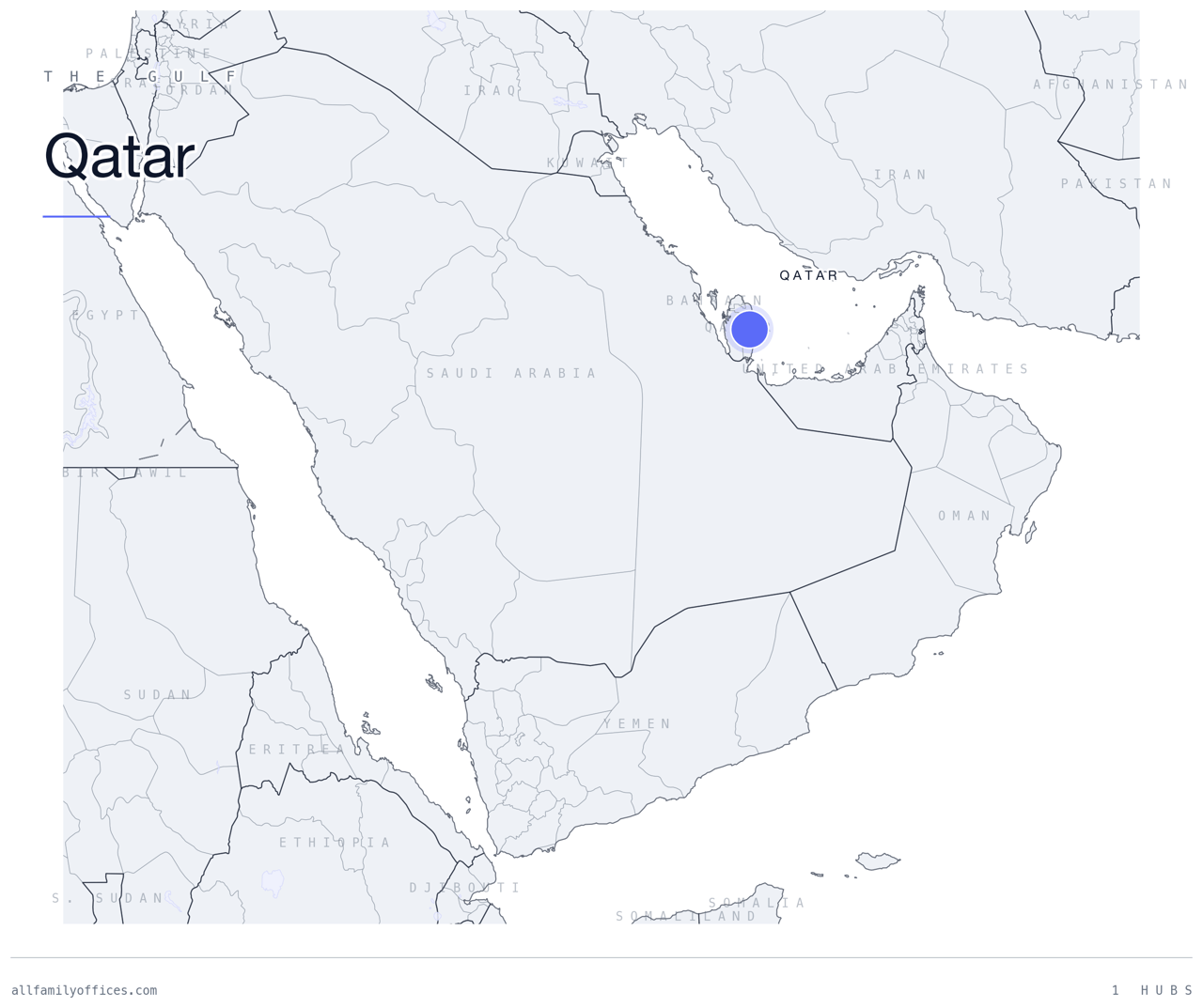
All major offices are headquartered in Doha, clustered in the West Bay financial district and the newer Lusail development. Their investment footprints, however, extend far beyond Qatar. Al Faisal Holding operates 35 hotels in the US, Europe, North Africa, and the GCC. Dilmon maintains offices in London and, as of 2025, Monaco. Alduwaliya has acquired commercial property in New York, London, Paris, and Birmingham.
Several structural factors fuel growth. The QFC provides a common-law jurisdiction with transparent rules and international arbitration, giving private wealth offices a regulated domicile option. Qatar's sovereign wealth fund offers co-investment opportunities that complement private family capital. LNG expansion revenue (Qatar plans an 85% output increase) generates new wealth for family-controlled structures. Unlike Dubai, which competes on volume and lifestyle branding, Qatar differentiates through sovereign wealth ecosystem proximity and tax-free status for both income and capital gains.
Family Office Comparison at a Glance
The table below compares Qatar's leading family offices by type, estimated AUM, allocation focus, and service scope. Offices are sorted by disclosed AUM, with undisclosed figures listed last.
| Family Office | Type | AUM Estimate | Investment Focus | Key Services | Location |
|---|---|---|---|---|---|
| The Family Office (TFO) | MFO | $2B+ | PE, private debt, real estate, alternatives | Tailored portfolios, Sharia-compliant options, digital platform | Bahrain/GCC |
| Al Faisal International for Investment | SFO (subsidiary) | $1.8B | Long-term global strategic allocations | Strategic investments, public equities, debt | Doha |
| Abuissa Holding | SFO/Conglomerate | $500M | Retail, telecom, energy, real estate | 30+ companies, 11 sectors, 9 countries | Doha |
| Alfardan Group | SFO/Conglomerate | $500M | Jewellery, property, automotive, hospitality | Luxury automotive, residential/commercial property | Doha |
| Mohamed Bin Hamad Holding (MBHH) | SFO/Conglomerate | $500M | Healthcare, hospitality, real estate, petrochemicals | Hospitals, hotels, alternative allocations | Doha |
| Almuftah Group | SFO/Conglomerate | $500M | Electronics, home appliances, diversified | Retail, distribution, after-sale service | Doha |
| Almana Group | SFO/Conglomerate | $500M | Trading, contracting, computer services | International partnerships, major projects | Doha |
| Al Faisal Holding | SFO/Conglomerate | $100M | Real estate, hospitality, tech, healthcare, energy | 50+ companies, 8 strategic clusters | Doha (West Bay) |
| Al Khor Holding | SFO | $100M | Industrials, energy, hospitality, PE, VC | Direct investments, public/private markets | Doha |
| Power International Holding | SFO/Conglomerate | $100M | Construction, real estate, agriculture, hospitality | Six sector-focused groups | Lusail, Doha |
| Darwish Holding | SFO/Conglomerate | $100M | Distribution, retail, real estate, technology | Integrated group, international partnerships | Doha |
| Dilmon | SFO | Undisclosed (multibillion) | Public markets, PE, luxury hospitality | Institutional-grade multistrategy platform | Doha, London, Monaco |
| Al Tharwa Family Office | SFO | Undisclosed | Real estate, natural resources, renewables, tech | Joint ventures, diversified financial planning | Doha |
Five offices cluster at the $500 million AUM level, while four sit at $100 million. Dilmon likely exceeds all others in total assets, but exact figures remain private. This reflects the broader opacity of Qatar's wealth management market.
Top Picks by Strategy
- Largest Disclosed AUM: Al Faisal International for Investment, with $1.8 billion deployed in long-term global strategic allocations spanning equities, debt, and private equity.
- Most Diversified Conglomerate: Abuissa Holding operates 30+ companies in 11 sectors in 9 countries, from retail and telecom to energy and construction.
- Leading International Hospitality Allocator: Al Faisal Holding manages 35 hotels in the US, Europe, North Africa, and the GCC through its ARTIC subsidiary.
- Top Pick for Institutional-Grade Strategies: Dilmon runs a multibillion-dollar multistrategy platform spanning public markets, private equity, and luxury assets like The Connaught in London.
- Strongest Healthcare Operator: Mohamed Bin Hamad Holding (MBHH) owns Doha Clinic Hospital, ICON Medical Center, and Crowne Plaza Hotel, combining healthcare with hospitality.
- Premier MFO Platform: The Family Office (TFO) manages $2B+ for multiple GCC families, offering Sharia-compliant options and a digital platform with a $300,000 minimum.
- Notable for Heritage and Luxury: Alfardan Group has a 70+ year legacy in jewellery, property, and automotive, with operations in five countries including Switzerland.
- Best for Cross-Border Real Estate: Alduwaliya acquired One Eleven Edmund Street in Birmingham for $29 million in 2025, adding to prior deals in New York, London, and Paris.
Top Family Offices in Detail
Al Faisal International for Investment
The largest tracked Qatari wealth platform by disclosed AUM, Al Faisal International manages $1.8 billion in long-term global allocations. It functions as the capital deployment subsidiary of Al Faisal Holding, investing through strategic stakes, public equities, and debt instruments. Its hotel portfolio alone spans 24 properties in the Middle East, Africa, Europe, and North America. Flagship assets include the 689-room Manhattan at Times Square Hotel in New York and the Boscolo Aleph Hotel in Rome. For allocators seeking a Qatari platform with institutional-scale reach, this is the benchmark.
Dilmon
Sheikh Hamad bin Khalifa Al Thani, Qatar's former Emir, built Dilmon as a multibillion-dollar multistrategy platform. The office invests in public markets, private equity, and strategic stakes in global companies, including holdings in Valentino SpA and Deutsche Bank AG. Dilmon also owns luxury hospitality assets such as The Connaught in London and the Maybourne Riviera near Monaco. In 2025, Dilmon received approval to establish operations in Monaco, expanding from its Doha and London bases. The leadership team includes CEO Abdulrahman Al-Mannai, CIO Stephane Monier, and Deputy CIO Arnaud Caussin. Among Qatari firms, Dilmon most closely resembles a Western institutional investor in structure and asset allocation.
Abuissa Holding
No other Qatari firm matches Abuissa Holding's geographic and sectoral spread relative to its size. With $500 million in managed assets, the office operates 30+ companies in 11 sectors, including retail, telecom, energy, and real estate. Its footprint spans 9 countries, with 47 branches, 12 warehouses, and 200 retail stores employing over 4,000 people. Chairman and CEO Ashraf Abu Issa has led the group since its founding in 1981 by his father, the late Abdul Rahim Abu Issa. Business owners exploring partnership models for market entry in the Middle East, North Africa, or Europe will find Abuissa's operating platform among the most developed.
Alfardan Group
A 70-year legacy in Qatar's pearl-trading heritage defines Alfardan Group under Chairman Hussain Ibrahim Alfardan. The group's $500 million portfolio spans jewellery, property development, luxury automotive, hospitality, marine services, and agriculture. Its international presence covers the UAE, Saudi Arabia, Oman, Türkiye, and Switzerland. Alfardan stands out for its focus on luxury and premium brands, representing prestigious automotive marques and developing high-end residential and commercial properties. This heritage-driven approach appeals to families prioritizing wealth preservation through tangible, brand-aligned assets.
Mohamed Bin Hamad Holding (MBHH)
Qatar's strongest healthcare-focused holding company, MBHH operates Doha Clinic Hospital, ICON Medical Center, and Crowne Plaza Hotel within its $500 million portfolio. The group also holds interests in petrochemicals, travel, and food and beverage. H.E. Sheikh Mohamed Bin Hamad Abdullah J. Al Thani founded MBHH over 50 years ago. The firm blends direct ownership of operating businesses with alternative allocations for portfolio balance. Families seeking exposure to Qatar's growing healthcare sector, which Vision 2030 elevated as a national priority, will find MBHH's track record in medical facility ownership directly relevant.
Al Faisal Holding
A parent conglomerate overseeing 50+ companies in 8 strategic clusters, Al Faisal Holding manages $100 million in AUM while its subsidiary deploys $1.8 billion. The group's pivot beyond real estate into technology, healthcare, manufacturing, and energy partnerships aligns with Vision 2030. Ali Mahmoudy, the chief strategy officer, described the pandemic as a turning point that pushed the family into new sectors. The TAWTEEN program, a QatarEnergy-led initiative to localize LNG supply chains, has opened further opportunities. Al Faisal plans to partner with established international players rather than build in-house energy expertise.
Power International Holding
Banana Island Resort and the Mall of Qatar anchor Power International Holding, a conglomerate that Moutaz Al-Khayyat and Ramez Al-Khayyat founded in 1983. Headquartered in Lusail, the group manages $100 million through six sector-focused groups covering construction, real estate, agriculture, food, hospitality, and entertainment. Each subsidiary operates independently while sharing group resources, a model that enables rapid scaling. International ventures in hospitality, telecom, and civil works extend the group's reach beyond Qatar.
Almana Group
A $500 million conglomerate with interests in contracting, computer services, and offshore operations, Almana Group evolved from a trading house into one of Qatar's broadest private wealth platforms. The group has partnered with major international companies on projects that support Qatar's civil works and economic development. Its corporate structure emphasizes joint ventures, making it a potential co-investment partner for firms seeking Qatar market access. Almana's workforce and project portfolio reflect a commitment to Qatari national development priorities.
The Family Office (TFO)
TFO is the primary multi-family office serving Qatari and GCC clients, managing over $2 billion in capital from its Bahrain base. The firm partners with top-tier international asset managers to offer private equity, private debt, real estate, and other alternative allocations. Minimum entry starts at $300,000, with Sharia-compliant options available. TFO also runs a digital platform for portfolio management. For families seeking shared expertise and cost efficiencies without a dedicated single family office, TFO fills a gap that few other regional advisors address at this scale.
Al Tharwa Family Office
Managing Director Fahad Al-Kaabi leads Al Tharwa, a Doha-based SFO investing in real estate, natural resources, private equity, luxury hospitality, renewable energy, and technology. The office operates through strategic joint ventures in the Middle East, Africa, and Europe. Al Tharwa's emphasis on renewable energy and technology positions it among Qatar's forward-looking firms. Its agile, partnership-driven approach allows faster market entry than the larger conglomerate models, making it relevant for co-investment partners targeting emerging sectors.
Trends Shaping Qatar's Private Wealth Market
Vision 2030 and Economic Diversification
Qatar National Vision 2030 is the single largest driver of family office strategy shifts in the country. Offices that once concentrated in real estate and hydrocarbons now allocate capital to manufacturing, healthcare, and technology. Al Faisal Holding's pivot into 8 strategic clusters beyond real estate reflects this broader realignment. QatarEnergy's TAWTEEN program has opened LNG supply chain capital deployment to private family wealth.
Technology and AI Allocations
Qatar's sovereign wealth fund recently launched a venture capital initiative to seed a local tech ecosystem. Family offices are following sovereign capital into fintech, cloud computing, and telecom. Al Faisal Holding is exploring technology-driven food production and distribution. TFO's digital platform signals that even wealth management itself is shifting toward tech-enabled models in the GCC.
International Real Estate and Hospitality
Qatari wealth managers maintain some of the most active cross-border real estate portfolios in the Gulf. Al Faisal Holding's ARTIC subsidiary manages 35 hotels on four continents. Alduwaliya acquired One Eleven Edmund Street in Birmingham for $29 million in 2025, its first UK purchase outside London. Dilmon's ownership of The Connaught and the Maybourne Riviera reflects a preference for trophy hospitality assets.
Sharia-Compliant and ESG-Aligned Investing
Among younger Middle East investors, 81% now consider sustainability factors in their decisions. 73% believe sustainable investing drives better returns. TFO offers Sharia-compliant portfolio options, while Al Tharwa has moved into renewable energy. The convergence of Islamic finance principles with ESG frameworks creates a distinctive lens for Qatar-based offices, blending succession planning values with measurable impact goals.
Food Security and Agricultural Capital Deployment
Qatar's near-total import dependence for food has driven family offices into agriculture, food tech, and supply chain management. Power International Holding operates agriculture and food industry subsidiaries. Al Faisal Holding is exploring technology-driven food production. As Qatar's population grows, food security has shifted from a national policy goal to a direct thesis for family capital, with $100M+ conglomerates like Power International leading the way.
How to Evaluate a Family Office in Qatar
Start with the conglomerate question. Most Qatari wealth platforms blend operating businesses with capital allocation functions under one holding company. Evaluate whether succession planning and portfolio management capabilities are distinct from the operating side, or whether your capital would be pooled with business operations. Abuissa Holding's 30+ subsidiary model differs sharply from Dilmon's dedicated multistrategy platform.
Sharia compliance readiness varies widely. All Qatar offices operate within an Islamic cultural context. However, the depth of Sharia-compliant structuring ranges from basic screening to full sukuk and murabaha capabilities. TFO offers formal Sharia-compliant portfolios, while conglomerate-style offices may rely on ad hoc compliance. Verify credentials with specific questions about fund structuring.
Succession readiness deserves special scrutiny in this market. Many of Qatar's largest offices were founded in the 1950s through 1980s, and several are still led by their founding generation. Alfardan Group's 70+ year history and MBHH's 50+ year track record both highlight this dynamic. Look for formal family councils, next-generation leadership roles, and documented family governance frameworks.
Assess portfolio concentration beyond hydrocarbons. An office with 70% of assets in energy-linked sectors carries meaningful risk despite Qatar's LNG dominance. Benchmark against diversified models: Abuissa spans 11 sectors, Al Faisal Holding covers 8 strategic clusters. Red flags include limited geographic spread and no formal asset allocation framework.
Access remains a practical challenge. Qatar's private wealth offices are among the most discreet in the region. Specialist wealth databases and QFC-hosted networking events are the most reliable entry points for fund managers seeking engagement. Cultural sensitivity to Islamic values and family traditions is not optional; it is a prerequisite.
Which Family Office Fits Your Needs?
UHNW families seeking wealth preservation through an institutional-grade platform should look first at Dilmon, which runs the closest equivalent to a Western endowment-style model in Qatar. TFO offers a multi-family alternative with lower minimums ($300,000) and shared access to top-tier global asset managers. This makes TFO the practical choice for families that want diversified alternatives without the cost of a standalone office.
Business owners evaluating operating partnerships in the Middle East or North Africa will find Abuissa Holding and Al Faisal Holding especially relevant. Both run large conglomerate platforms with dozens of portfolio companies and established joint venture frameworks. Abuissa's 9-country footprint and Al Faisal's 35-hotel network provide built-in distribution and operational scale.
Next-generation wealth holders should prioritize offices with formal oversight structures and documented succession plans. QFC-hosted family office showcases connect rising leaders with best practices in family governance. For real estate-focused allocators, the choice depends on geography: Al Faisal Holding for global hospitality, Power International Holding for Qatar domestic projects like Mall of Qatar, and Alduwaliya for European commercial property at sub-$100 million ticket sizes.
Methodology
This guide to the family offices in Qatar market draws on data from industry databases, public filings, institutional research, and direct office disclosures. Offices were selected based on documented AUM or verified portfolio activity, with preference for Doha-headquartered or Qatar-primary operations. Each office was evaluated on track record, sector and geographic spread, oversight quality, and service scope. AUM figures reflect the most recent public estimates as of early 2026. Offices without reliable figures are marked "Undisclosed." Qatar's private wealth firms operate with notable privacy, and some data gaps remain, especially around exact portfolio allocations and fee structures.
Frequently Asked Questions
At least 14 have been documented, with nearly all headquartered in Doha. The market is dominated by single family office and conglomerate models. Given Qatar's ranking as 3rd globally in millionaires per capita (116 per 1,000 households), additional undisclosed offices likely exist. The QFC actively works to attract more through regulatory incentives and partnerships with industry research groups.
Al Faisal International holds the largest disclosed AUM at $1.8 billion, focused on long-term global strategic allocations. Dilmon, the office of former Emir Sheikh Hamad bin Khalifa Al Thani, manages a multibillion-dollar portfolio but does not disclose exact figures. TFO, operating as an MFO from Bahrain, manages over $2 billion for multiple GCC families.
A single family office serves one family only, offering fully tailored and private wealth management. A multi-family office serves several families, sharing costs and expertise. Qatar's market is overwhelmingly SFO-driven, with most offices structured as diversified holding companies rather than pure capital allocation vehicles. TFO is the primary MFO serving Qatari clients, offering access to private equity, private debt, and real estate from a $300,000 minimum.
Traditional allocations center on real estate, hospitality, and energy. Capital is now flowing toward technology, healthcare, manufacturing, and food security, driven by Vision 2030 priorities. Al Faisal Holding has pivoted into 8 strategic clusters beyond real estate. Qatar's sovereign wealth fund venture capital initiative is pulling private capital toward fintech, cloud computing, and AI. International hotel and commercial property deals remain active.
Qatar charges zero personal income tax and zero capital gains tax. The QFC offers a common-law legal framework with international arbitration and transparent rules. Proximity to Qatar's sovereign wealth fund provides co-investment opportunities and sovereign-backed deal flow. Growing LNG revenues continue to generate new family wealth. QFC partnerships with industry groups actively promote Qatar as a regional hub for wealth stewardship.
These offices are highly private and rarely accept unsolicited outreach. Specialist wealth databases provide identification and contact data for verified institutional users. QFC-hosted periodic showcases enable direct networking with Qatari families and their advisors. Fund managers and allocators should expect longer engagement timelines than in Western markets. Cultural alignment with Islamic values and respect for family traditions are essential for productive relationships.